
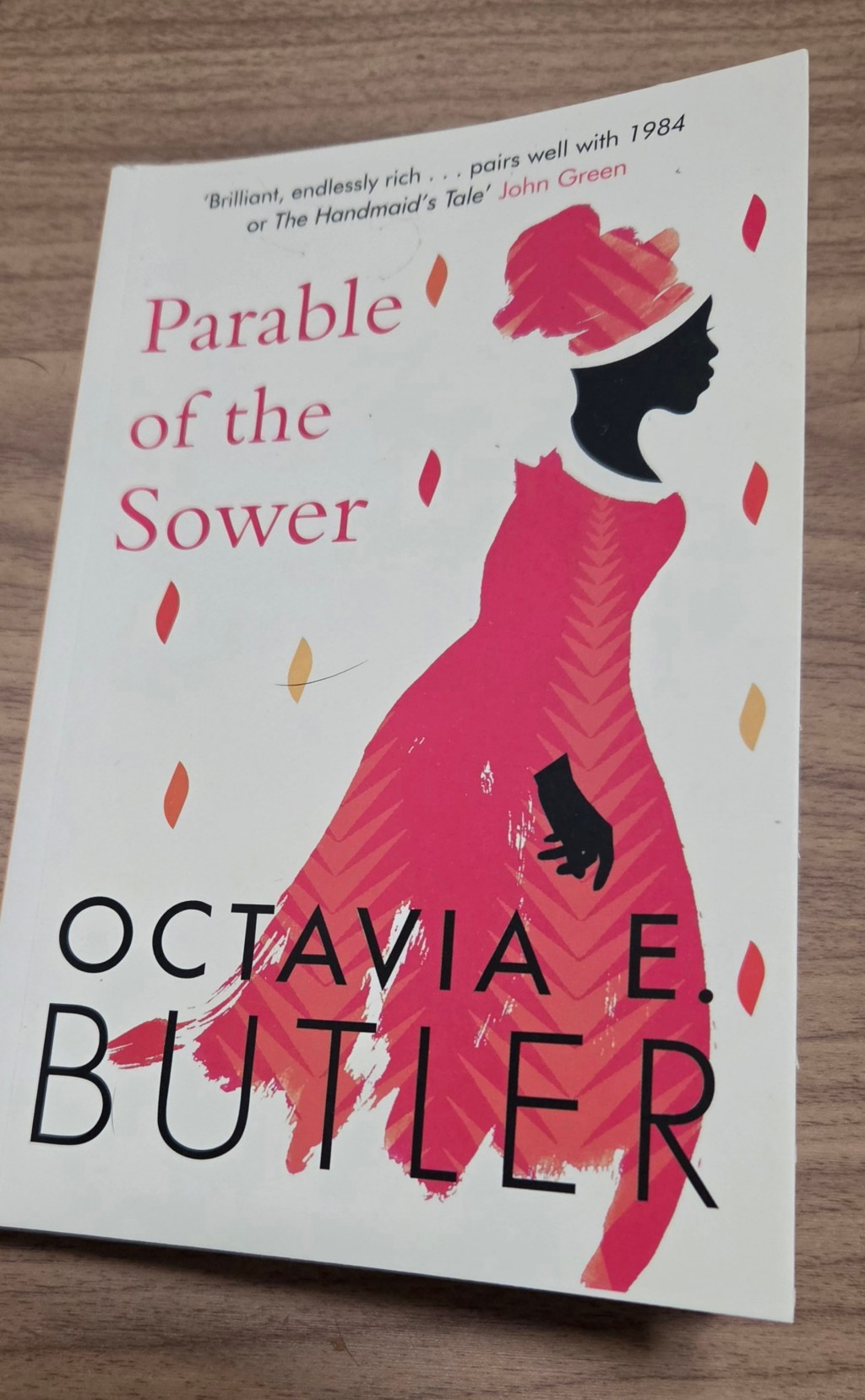
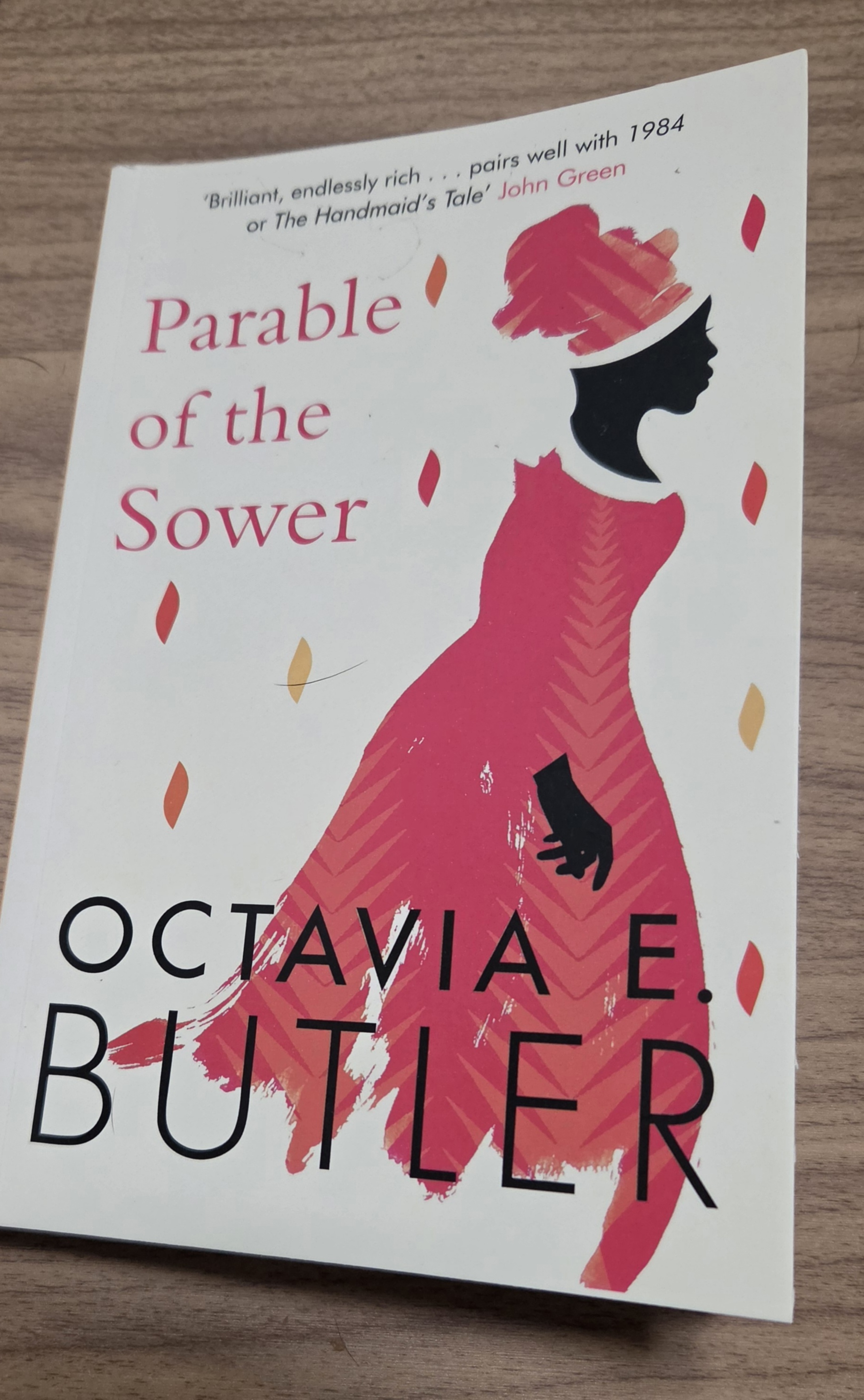
Disclaimer: My book reviews are not intended for people who have not yet read the book. I may occasionally divulge details of the story. Please remember that this is only my opinion of the book.
Whew! This was a difficult read for me. It kept me interested, much like when I read Butler’s Kindred several years ago. Her books, at least the ones I’ve read so far, tackle subjects that are educational, somewhat disturbing, but also deeply real and incredibly relevant.
Reading Parable of the Sower was especially interesting because I picked it up in 2026—the same year that many of the events in the novel begin to unfold. Considering the book was published in 1993, it almost feels as though Butler was predicting parts of the future, which is wild.
The novel begins with Lauren Olamina, a 17-year-old girl living in a dystopian version of California. Early on, Lauren reveals that she doesn’t believe in the same God her father preaches about. That statement alone immediately grabbed my attention. From the very beginning, she explains that she has a different understanding of God and begins writing down a set of beliefs she calls Earthseed. In Chapter 2, Lauren writes, “My God has another name.”
That statement immediately signaled to me that Lauren thinks very differently from those around her—especially her father.
By the year 2024, the world has become almost unrecognizable. People live in walled communities for protection while violence, theft, and arson have become commonplace throughout California. A dangerous drug has gained popularity among people who are obsessed with setting fires. Basic necessities like food and clothing are scarce, and most families survive by working together, hunting, and growing their own food. Leaving the safety of the community walls is dangerous, so people usually travel in groups for fear of both wild animals and desperate people.
Lauren senses from the beginning that the walls won’t keep danger out forever, especially after a neighboring house is robbed one night. Against her father’s wishes, she has already prepared a survival pack filled with necessities in case she ever has to flee. She also dreams of eventually leaving with her boyfriend and getting married, although he sees the world—and their future—very differently than she does.
After a tragic series of events involving her father, her brothers, and her community, Lauren is forced onto an unexpected journey north much sooner than she ever anticipated. Two members of her community join her, and others become part of the group along the way.
Lauren and what eventually grows into a group of nine people spend every moment focused on survival. Amid all the chaos, Lauren begins sharing her Earthseed philosophy and her dream of building a new community founded on its principles. Some reject her ideas outright, while others are curious or skeptical.
What I found especially interesting is that, despite everything happening around her, Lauren never loses her desire to create something better. She genuinely believes the world can change—and that people can help shape that change.
When I first saw the title of this novel, as a Christian, my mind immediately went to the Parable of the Sower found in Matthew 13:3–9. Ironically, that passage also speaks of seeds being sown on different types of ground and how different people receive the truth. I couldn’t help but think about that connection while reading.
One thing I appreciate about Butler’s writing is how she explores different ways of thinking, different worlds, and different timelines. In Kindred, we move between slavery in the early 1800s and the modern world of the 1970s. In Parable of the Sower, Butler instead takes us into a possible future, with the novel concluding in the year 2027.
The repeated phrase, “God is Change,” also resonated with me. I’d actually like to write a separate piece discussing that idea because I think there’s a lot to unpack there.
Octavia E. Butler was truly an artist, painting entire worlds with words.
I’m excited to continue the story by reading the sequel, Parable of the Talents.


Leave a Reply