
written by Nicole Alicia
Disclaimer: My book reviews are not intended for people who still plan to read the book. I may occasionally reveal details of the story. As always, these reviews are simply my personal opinions.
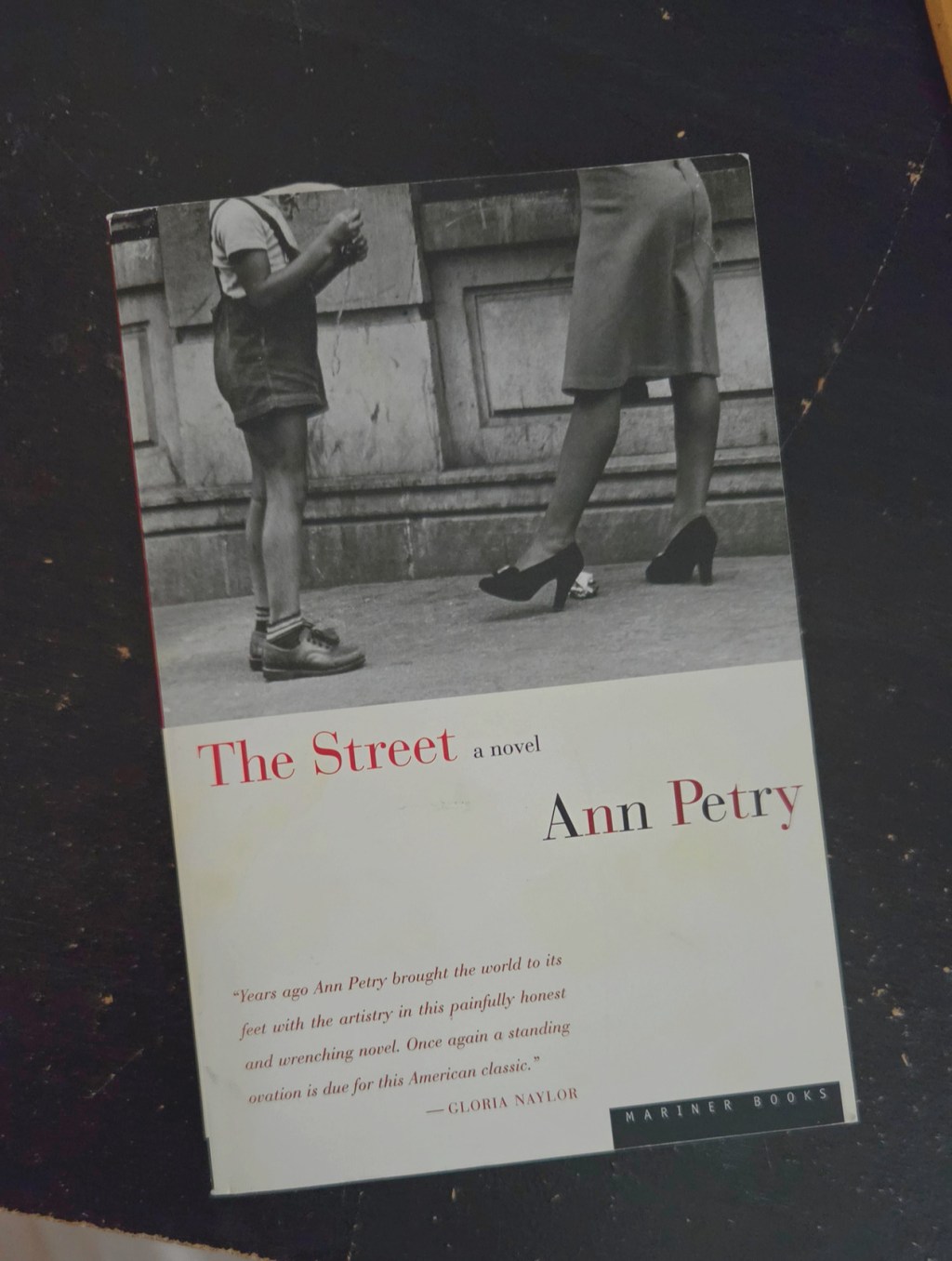
This was my first Ann Petry novel, and ironically, it was also the first novel she ever published.
I don’t believe I had ever heard of Petry before I searched for “good books by African American authors that take place in the 1940s.” Why you ask was I looking for such a specific genre? Well I’ll explain later. Since The Street was published in 1946, this book seemed like a pretty good choice.
Why was I searching for books set during that time period? I had recently decided to pick back up a novella manuscript I started in 2019 that also takes place during the 1940s. Whenever I begin a new book, I usually like to learn a little about the author first. I was amazed to discover that Ann Petry was the first African American woman to sell more than one million copies of a book. That fact alone made me even more excited to read her work.
I’ve always enjoyed novels set in different historical periods, and seeing that this one took place in 1940s Harlem immediately caught my attention.
The story begins with the main character, Lutie Johnson, searching for an apartment after her marriage falls apart. While working during the week as a domestic for a wealthy white family, she discovers that her husband has moved another woman into their home. Now a single mother, Lutie is left to find an affordable place where she and her young son, Bub, can live.
When Lutie first views the apartment, she isn’t impressed. Even worse, she immediately gets unsettling vibes from the building superintendent, Mr. Jones—better known as “the Supe.” As it turns out, her instincts are absolutely correct. That uncomfortable feeling is only the beginning.
One of the things I appreciated most about Petry’s writing was her incredible use of imagery. Many passages almost read like poetry, with vivid descriptions that made every street corner and apartment come alive.
“She looked at the outside of the building. Parquet floors here meant that the wood was so old and so discolored no amount or varnish or shellac would conceal the scars and the old scraped places, the years of dragging furniture across the floors, the hammer blows of time and children and drunks and dirty, slovenly women.”
Lutie spends nearly every day working and worrying—worrying about money, worrying about Bub, and worrying about whether she’ll ever be able to build a better life. Unfortunately, Bub senses her anxiety and begins worrying too. Wanting to help his mother financially, he becomes vulnerable to manipulation by adults who should have known better.
Throughout the novel we meet unforgettable characters, including Mrs. Hedges, the woman who watches over the street from her window, Mr. Jones, Mr. Junto, Boots Smith, and several others whose motives become increasingly questionable as the story unfolds.
One aspect of the novel that really stuck me was how vulnerable single women could be when they had little money or support. Petry does an excellent job of showing how predators often targeted women who had very few options.
The manipulation of Bub by Mr. Jones was especially difficult to read. It was heartbreaking to watch an innocent child become caught up in the schemes of selfish adults. Mr. Jones seemed to believe that women somehow owed him something, and his behavior throughout the novel was disturbing.
Mrs. Hedges was another fascinating character. At first she appears to be the neighborhood woman who knows everyone’s business and watches over the block. As the story unfolds, however, we learn that she also profits from the desperation of vulnerable women by acting as a madam.
Then there’s Boots Smith—a smooth-talking, abusive bandleader working for Mr. Junto—who proves to be just as manipulative in his own way.
One line that stayed with me came in Chapter 8:
“All the responsibility for Bub was hers.”
That sentence perfectly captures the weight Lutie carries throughout the novel. Every decision she makes affects not only her own future but Bub’s as well.
I think one of Petry’s central messages is how dangerous certain environments can become when poverty, desperation, and manipulation intersect. Children who are left exposed to those influences can suffer devastating consequences, even when their parents are doing everything they can to survive.
Characters like Min eventually escape Mr. Jones’s control, while others are not so fortunate. Lutie, Min, and Mary are all portrayed as vulnerable women whom men like Mr. Jones, Boots Smith, and Mr. Junto see as prey. Sadly, that kind of exploitation still exists today.
One thing I struggled with as a mother was seeing Lutie leave Bub home alone so often. I understand the story takes place during a different era, when circumstances were very different and she had few choices. Still, Bub was only nine years old. He was frightened of sleeping with the lights off, yet he spent long hours alone while Lutie worked. Despite her warnings never to let strangers into the apartment, his innocence and trusting nature made him especially vulnerable. He was intelligent, but he simply wasn’t streetwise enough to recognize danger.
Overall, I think there are many lessons to be found in this remarkable novel. Petry created a compelling story filled with suspense, memorable characters, and a realistic portrayal of life in 1940s Harlem.
That said, I did not like the ending.
As a mother, I found Lutie’s final decision incredibly difficult to accept. Even understanding the lack of opportunities and resources available to her at the time, the ending left me feeling frustrated and heartbroken.
Even so, I’m very glad I discovered Ann Petry. This certainly won’t be the last of her books that I read.
Have you read The Street? What were your thoughts?
I’d love to hear them in the comments. Let’s discuss.


Leave a Reply